
Practices that promote deep relaxation offer an opportunity to close the doors to the outside noise and to go within. With a relaxed body and calm mind, being with oneself, in the moment, can be sublimely restorative. Meditative relaxation practices entail bringing awareness to the body, letting go of physical tension, and noting one’s experience with no judgement – simply experiencing the moment. When thoughts arise, as they inevitably will, witness but do not try to control or analyze. Simply being present – in the moment – fosters a state of being that can be, with practice, restorative and empowering. Taking time to integrate meditative relaxation practices on a regular basis
- reduces stress
- promotes a restful state of being and restores
- integrates body and mind
- improves body awareness
- enhances problem solving and creativity
- regular meditative relaxation can deepen connection to one’s intuition
There are multiple ways to experience a state of deep relaxation:
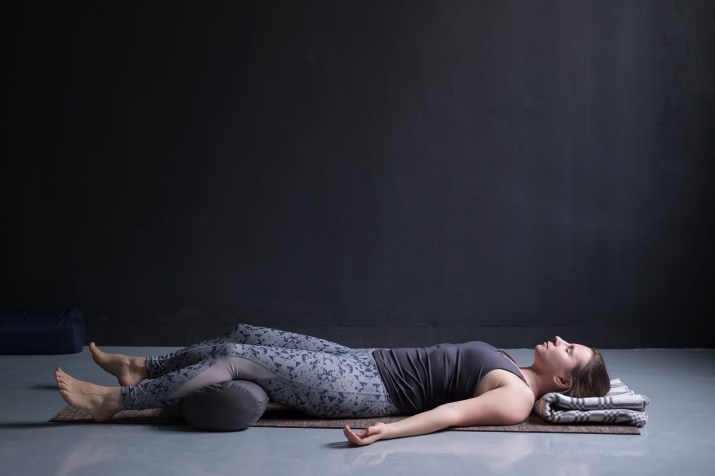
Savasana: The word means corpse pose in Sanskrit. It is usually done as the last asana in a yoga class. Lying supine in a position that supports relaxation, the pose usually will last for five to ten minutes. You can choose to stay longer. Savasana promotes integration of the yoga poses that preceded. With practice, a person can learn how to relax not only the body but also quiet the mind. Some suggest that this is the gateway to self realization or self empowerment. In his book Yoga: The Path to Holistic Health, B.K.S Iyengar writes, “Relaxation begins from the outer layer of the body and penetrates the deeper layers of our existence (172).
Body Scan: To begin, one lies supine on a padded surface such as a yoga mat placed on the floor. It is important to find a comfortable position that supports relaxation. Props may be beneficial in helping to alleviate discomfort. For example, a bolster pillow can be used for under the knees or/and a pillow to support the head. A warm blanket can be useful as feeling cold can make it difficult to relax and move into a relaxed, restful state. Body scanning puts intention on bringing awareness to one’s body as a whole as well as specific areas of the body: toes, feet, thighs, hips, sacrum, abdominals, ribcage, diaphragm, hands, arms, and on up the body. One observes and notes how each part of the body feels such as temperature, weight, feelings of tension and other sensations. Following, one can meditate by bringing the attention to the breath and simply being in this moment. A deeply restful state requires the mind to step aside. Recognize that it is natural for thoughts to arise; as they do, avoid judgment, simply observe them and let them go. With consistent practice, it becomes easier to move deeper into the practice. The idea is to move into an aware and restful state while not falling asleep. Body scan meditation likely came about from long ago Buddhist mindful meditation traditions. In the 1970’s Jon Kabat-Zinn brought body scan meditation to a large western audience as part of his Mindfulness-Based Stress Reduction (MBSR) Clinic. His teaching and contribution linking mindfulness to improved health and well being has led to “a growing movement of mindfulness into mainstream institutions such as hospitals, schools, corporations, prisons, and professional sports organizations” (Kabat-Zinn, 165). He is the author of Mindfulness for Beginners, Wherever You Go, There You Are and numerous other books.
Guided Imagery uses deep relaxation and visualization to help manifest certain goals. The participant begins by lying supine on a well padded mat on the floor (or sits in a comfortable chair) and is guided into a state of relaxation by a therapist or instructional audio. Alternatively, the participant can come up with their own script, read and record the script, and play the audio for their guided meditation. Guided imagery can be used for a number of different objectives. For example, visualizing a calm and happy environment in nature (images, sounds, and smell) can help alleviate stress, anxiety, and promote a sense of wellbeing. Guided imagery can also be used to enhance performance. Professionals in sport related fields often use imagery to enhance achieving their goals. To enhance performance a gymnast might review in her or his mind an intended well performed gymnastic move. Guided imagery can also be used to help heal or alleviate pain, discomfort. It is important to note that professional medical advice and treatments is always recommended.
While it does come more easily to some than others, visualization skills will improve with practice. In his book Your Past Lives, Michael Talbot offers an exercise for those who find it difficult to visualize: Closing one’s eyes, the person visualizes the room they are in with as much detail as possible. If necessary, one can open their eyes and view the room, taking note of furniture and other details potentially missed. With eyes closed, the exercise continues, “making your mental image as real as possible and holding it for as long as you can” (Talbot, 98).
Floatation: Floatation-REST (Reduced Environmental Stimulation Therapy) provides an environment that is designed to promote a meditative state and inner perception. For those who have never meditated or have found meditation difficult, floating can be a helpful introduction. In a Ted Talk presentation titled The Amazing Thing That Happens When You Disconnect, Neuroscientist Dr. Justin Feinstein describes a floatation study where participants with high anxiety, and in some cases depression, “reported the spontaneous induction of a meditative state” (Feinstein, 2020, 15:15). Studies have shown that floatation reduces anxiety (8:23), reduces blood pressure (11:37) and relieves muscle tension and pain (9:45). Floatation occurs in a shallow mixture of water and magnesium sulfate. The high concentration of epsom salt allows one to float effortlessly, creating a sensation of weightlessness and freedom from the usual effects of gravity. Floatation tanks come in various forms, including cabin rooms, pods, and open pools. All offer equal benefits. Cabin rooms and open pools, however, are good options for those who might avoid floating due to claustrophobic feelings of being in a small space for a long time.
A floatation spa offers the client a private room for the full sixty or ninety minute float session. The room comes equipped with a shower, float cabin, pool, or pod. It is important to shower before and after your float session to wash and shampoo off oils before entering the float tank and wash off salts following. Floating is usually done with no clothes on. A float cabin has a swing door for easy access in and out of the cabin. A person can choose to float the entire session in complete darkness and no sound or to float with dim lights on; as well as have relaxing music. Ideally the float lasts the entire session; however, a person is free to step out of the float tank at any time if they wish. The room allows for complete privacy for the entire session.
With all meditative practices, experience enhances the ability to move deeper into the practice.
References:
TED. (2020, May7). The Amazing Thing That Happens When You Disconnect/ Justin Feinstein . YouTube. https://www.bing.com/videos/search?q=justin+feinstein+ed+talks&view=detail&mid=09C93A9C1892200FCE6B09C93A9C1892200FCE6B&FORM=VIRE
Iyengar, B.k.S. (2001, 2014). Yoga: The Path To Holistic Health. DK Publishing.
Kabat-Zinn, Jon. (2012, 2016) Mindfulness For Beginners. [ebook edition]. Sounds True, Inc.
Talbot, Michael. (1987). Your Past Lives. Harmony Book/New York.
 Massage For Well Being